

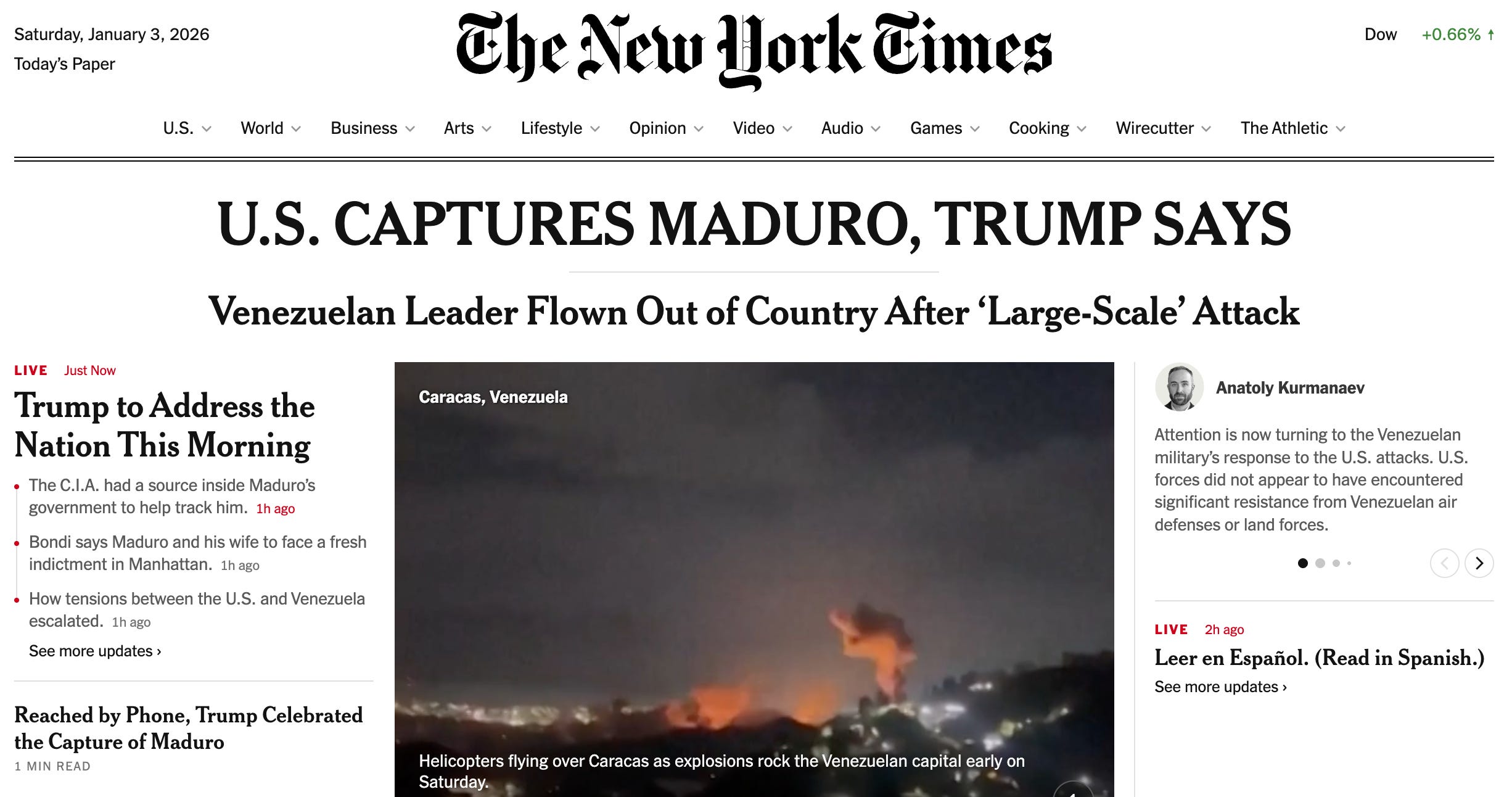
The news of the U.S. attack on Venezuela and seizure of President Nicolás Maduro is still breaking, so this is just a very preliminary take on the situation. But I do think it is very important that some of the core issues are properly understood, particularly by the media. There will be time later to discuss more of the nuance and to consider more deeply the broader implications. For now, however, this will provide some basic analysis of the legal issues implicated by the actions thus far reported.
The Unlawful Use of Force
The scale of the military intervention that has been reported unquestionably made it a “use of force” as that term is understood for purposes of Article 2(4) of the U.N. Charter. Article 2(4) prohibits the use of force against the political independence and territorial integrity of any other state. There are two established “exceptions” or “justifications” (for those who are interested in the theoretical distinction, I encourage you to listen to two podcast episodes, here and here) to this prohibition: (1) individual or collective self-defense, as provided for in Article 51 of the U.N. Charter; and (2) use of force authorized by the U.N. Security Council, under Article 42 of the U.N. Charter, to restore or maintain international peace and security.
The second justification is clearly not satisfied here, as there is no such authorization. To justify an exercise of self-defense under Article 51, a state must be responding to an “armed attack,” and the use of force must be both necessary to prevent the continuation of such attacks, and be proportionate—to either the gravity of the armed attack itself, or to the legitimate ends of the act of self-defense (there are contending theories on the principle of proportionality). For our purposes, we need go no further than the “armed attack” condition—there has been no armed attack on either the U.S. or any other neighboring state that could possibly justify a use of force in self-defense.
The International Court of Justice (ICJ) has held (initially in Military Activities, Nicaragua v. United States) that an “armed attack” is the most grave form of a use of force. Efforts by the U.S. to characterize illicit drug shipments to the U.S., as somehow constituting an armed attack because they ultimately result in thousands of overdose deaths in the U.S., do not remotely come close to even the broadest conceptions of “armed attack” (leaving aside the factual problems with these claims, since Venezuela plays little role in the flow of fentanyl into the U.S.).
The military intervention is an unlawful use of force and an act of aggression in violation of the fundamental prohibition on the use of force—a rule that is considered a jus cogens norm, that is a peremptory norm of international law that permits of no derogation by states.
Unlawful Intervention
In addition to the prohibition on the use of force, international law imposes a prohibition on the intervention in the internal affairs or domaine réservé of other states. Article 2(7) of the U.N. Charter provides for the fundamental sovereignty of states, and a number of U.N. General Assembly resolutions (specifically the Declaration on Friendly Relations, UNGA Res. 2625, and the Declaration on the Inadmissibility of Intervention, UNGA Res. 2131) have articulated and confirmed the customary international law principle that states are prohibited from intervening in the internal policy other states.
The scope of what constitutes unlawful intervention is open to some debate. But it is pretty much universally accepted that it at a minimum includes coercive interference in the state’s political independence and matters that are considered central to the domaine réservé—that is, the constitutional order, leadership succession, internal security arrangements and the like.
The forceful seizure and abduction of the sitting head of state, regardless of the extent to which he or she is thought to be democratically illegitimate, is unquestionably a coercive interference in the governance of the state, and constitutes unlawful intervention.
Unlawful Exercise of Extraterritorial Enforcement Jurisdiction
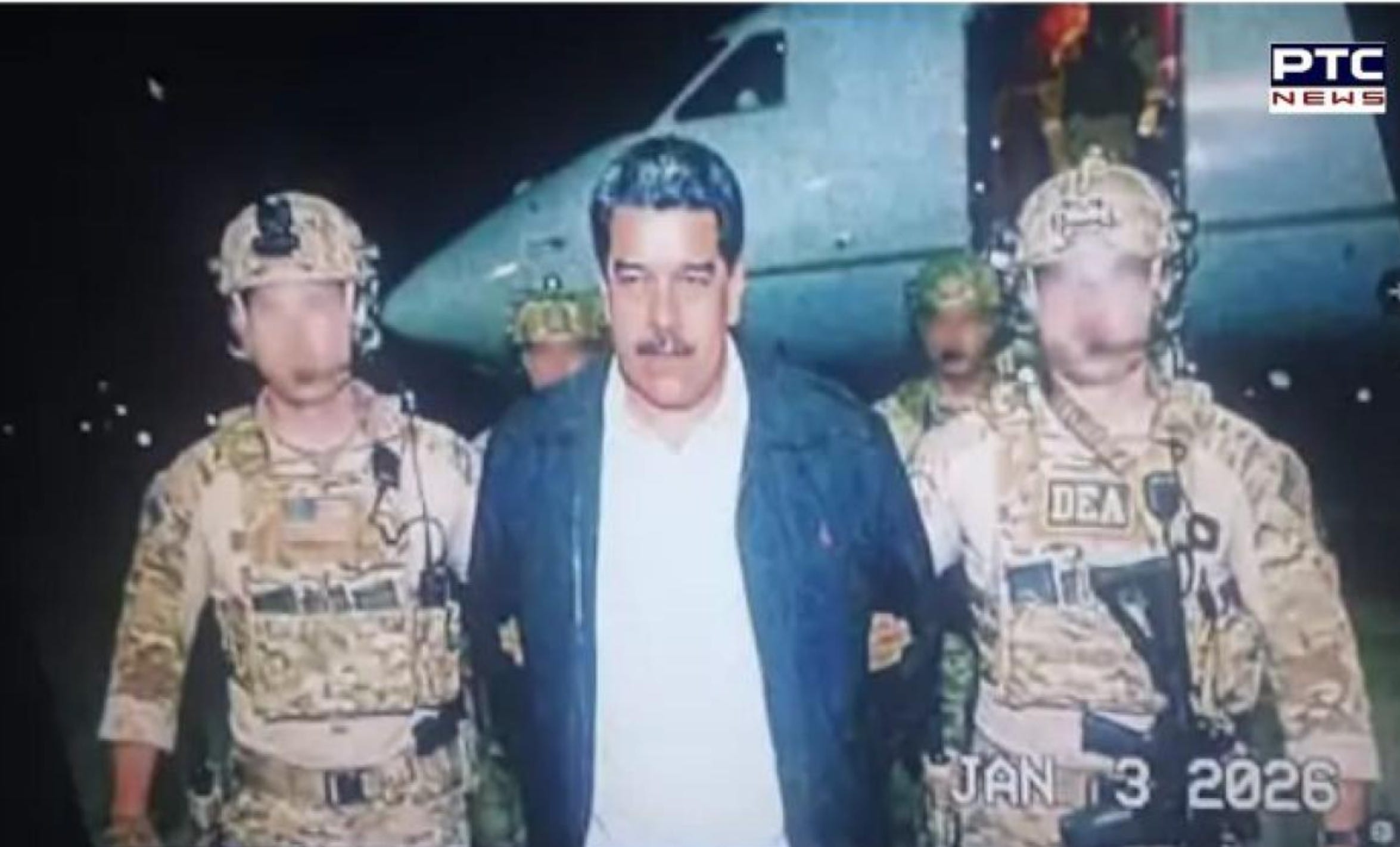
The seizure and abduction of President Maduro for purposes of indictment and prosecution constitutes an extraterritorial exercise of enforcement jurisdiction—that is, the actions of agencies of the U.S. government to enforce American law within the territory of another state—actions such as arrest, seizure, detention, and extraction.
As I have explained in prior essays here, on the extrajudicial killings and seizure of oil tankers in international waters off of Venezuela, international law prohibits the exercise of prescriptive, adjudicative, and enforcement jurisdiction outside the territory of the state, subject to certain exceptions. The prohibition on extraterritorial enforcement jurisdiction is the strictest, as enforcement within the territory of another state is the most offensive to the sovereignty of that state, and has fewer and narrower exceptions.
Thus enforcement actions in the form of “snatch” operations are typically prohibited in the absence of state consent or narrow treaty-based exceptions or exemptions. The paradigmatic example is the Israeli seizure and abduction of Adolf Eichmann in Argentina in 1960. Notwithstanding the universal condemnation and reviling of Adolf Eichmann for his role in the Holocaust, the abduction was viewed as a violation of international law. The U.N. Security Council considered the action to be a violation of Argentinian sovereignty, declared the action to be incompatible with the U.N. Charter framework that endangered international peace and security, and called upon Israel to make reparations to Argentina.
The seizure and abduction of President Maduro is thus a flagrantly unlawful extraterritorial exercise of American enforcement jurisdiction within the territory of Venezuela.
The Coming Violation of Immunity
Under the international law principles on immunity, a sitting head of state, as well as other senior ministers, enjoy absolute immunity from prosecution or legal proceedings in the domestic courts of other states. The intention to indict and prosecute President Maduro in American courts will unquestionably violate that fundamental rule.
A few features of this perhaps need to be explained. First, immunity does not mean impunity—this rule of international law does not provide impunity to senior government leaders who are guilty of international crimes. They can be tried before international tribunals, and they can also be tried in the courts of their own country. Recall that the International Criminal Court (ICC) has issued arrest warrants for both President Putin and Prime Minister Netanyahu, and senior ministers have been tried before several international tribunals going back to the Nuremberg and Tokyo tribunals.
Second, sitting heads of state and senior ministers enjoy a different form of immunity than former former heads of state and senior ministers. This became clear in the historic and groundbreaking case of Augusto Pinochet in the House of Lords proceedings in the U.K. in 1998-99, to review whether Pinochet could be extradited to Spain to stand trial for torture. Former heads of state enjoy only a limited form of immunity from proceedings in foreign courts, covering only official acts while they were in office (known as ratione materiae), while sitting heads of state and senior ministers enjoy virtually absolute immunity in foreign courts (ratione personae). And, to be very clear, the immunity is not that of the individual, but rather it is an immunity that belongs to the state that they represent.
Thus, Pinochet was found not to have immunity for charges of authorizing and ordering acts of torture, whereas the ICJ found that the sitting foreign minister of the Democratic Republic of Congo did have immunity from prosecution in Belgian courts for his role in torture and other international crimes (the Arrest Warrant Case (DRC v. Belgium)).
Third, the alleged democratic illegitimacy of the head of state’s position does not alter his or her status as a matter of international law. The U.S. and many other states have alleged that Maduro effectively rigged the last two elections in Venezuela, and that opposition members actually won those elections. That is indeed likely true. But from the perspective of international law the government of Maduro continues to exercise de facto and effective control over the population and territory of Venezuela, through the effective control of all the agencies and institutions of the state. His government remains the effective government of Venezuela.
In short, the intention to prosecute President Maduro, the sitting head of state of Venezuela, will violate immunity of Venezuela, and the principles of international law that provide for that immunity.
Conclusion
There is much more to be said about all of this, including the profound implications for the international legal order. This set of events represent yet another case of brazen disregard for, and violation of, fundamental rules and principles of international law by the Trump Administration. These violations all serve to undermine and weaken a system that has helped provide international peace and security, and relative prosperity, since World War II. I will have more to say about that in future posts (and until then, for those interested, I recently had a fascinating discussion on aspects of this in a podcast episode with Monica Hakimi of Columbia Law)—but for now, this short essay is intended to just provide a quick basic analysis of the legal issues implicated.
Hello Craig,
This was a very insightful read. The use of evidence, coupled with a simplistic explanation of it, makes the concepts easy and memorable.
Additionally, no country holds the authority of a 'global police force'. None.
This transcends to the Iran issue, with the assassination of the Iranian Supreme Leader.
No country on earth holds the right to 'restore peace to another' or use disproportionate, unprovoked force against another
Finally, State Sovereignty as an international obligation was breached, and its characterisation as lawful or not by US Laws is irrelevant to international law.
An insightful read, I must say.